
Resources → Reference
Raptor Weight Charts for Falconry
Weight management is the foundation of falconry. A hawk at the correct flying weight is responsive, motivated to hunt, and physically healthy. These charts provide baseline weight ranges for the most commonly flown species in North American falconry, along with guidance on how to determine your individual bird’s optimal flying weight.
Why Weight Management Matters
In falconry, a raptor’s responsiveness to the falconer is directly tied to its appetite, which is controlled through careful weight management. A bird that is too heavy (above its flying weight) will have little motivation to return to the fist or chase quarry. A bird that is too low (below safe flying weight) will be lethargic, weak, and at risk of serious health problems or death.
The goal is to find a narrow weight range - typically 5–10% below the bird’s fat (free-feeding) weight - where the bird is alert, responsive, and eager to hunt while maintaining enough energy reserves to fly strongly and safely. This range is called the flying weight or hunting weight.
Every individual bird is different. The charts below provide species-level averages, but your specific bird’s flying weight must be determined through careful observation over days and weeks of training. There is no shortcut to this process.
How to Determine Flying Weight
- Establish a baseline. When you first acquire your bird (whether trapped or from a breeder), weigh it daily at the same time for the first week. This gives you its starting weight.
- Reduce gradually. Lower the bird’s weight slowly - no more than 3–5% per week - by controlling food portions. Never starve a bird to achieve rapid weight loss.
- Watch for response. As weight decreases, the bird will begin to show interest in food on the glove, then willingness to jump to the fist, then willingness to fly increasing distances. The weight at which the bird flies eagerly and returns immediately is near its flying weight.
- Fine-tune. Once you identify the approximate flying weight, make small adjustments (5–10 grams for large hawks, 2–5 grams for small hawks and kestrels) based on daily performance, weather, and activity level.
- Record everything. Keep a daily log of weight, food given, weather conditions, and hunting performance. Patterns will emerge over weeks that help you predict your bird’s needs.
Buteo Weight Charts
Buteos are broad-winged soaring hawks. The Red-tailed Hawk is the most commonly flown buteo in American falconry and is one of the two species available to apprentice falconers. Harris’s Hawks are popular at the General level for their social hunting behavior.
| Species | Sex | Avg. Weight (g) | Typical Flying Weight (g) | Fat Weight (g) |
|---|---|---|---|---|
| Red-tailed Hawk | Male (tiercel) | 1,030 | 900–1,000 | 1,100–1,200 |
| Red-tailed Hawk | Female | 1,220 | 1,080–1,180 | 1,300–1,450 |
| Harris’s Hawk | Male | 735 | 650–720 | 780–850 |
| Harris’s Hawk | Female | 1,020 | 900–1,000 | 1,080–1,200 |
| Ferruginous Hawk | Male | 1,050 | 950–1,020 | 1,100–1,200 |
| Ferruginous Hawk | Female | 1,400 | 1,250–1,370 | 1,500–1,650 |
Accipiter Weight Charts
Accipiters are short-winged woodland hawks built for explosive speed through dense cover. Cooper’s Hawks and Sharp-shinned Hawks are the most commonly flown accipiters in American falconry. They require more precise weight management than buteos due to their smaller size and higher metabolic rate.
| Species | Sex | Avg. Weight (g) | Typical Flying Weight (g) | Fat Weight (g) |
|---|---|---|---|---|
| Cooper’s Hawk | Male | 350 | 300–340 | 370–420 |
| Cooper’s Hawk | Female | 530 | 460–515 | 560–640 |
| Sharp-shinned Hawk | Male | 105 | 90–100 | 110–125 |
| Sharp-shinned Hawk | Female | 175 | 155–170 | 185–210 |
| Northern Goshawk | Male | 900 | 800–880 | 950–1,050 |
| Northern Goshawk | Female | 1,140 | 1,020–1,120 | 1,200–1,350 |
Falcon Weight Charts
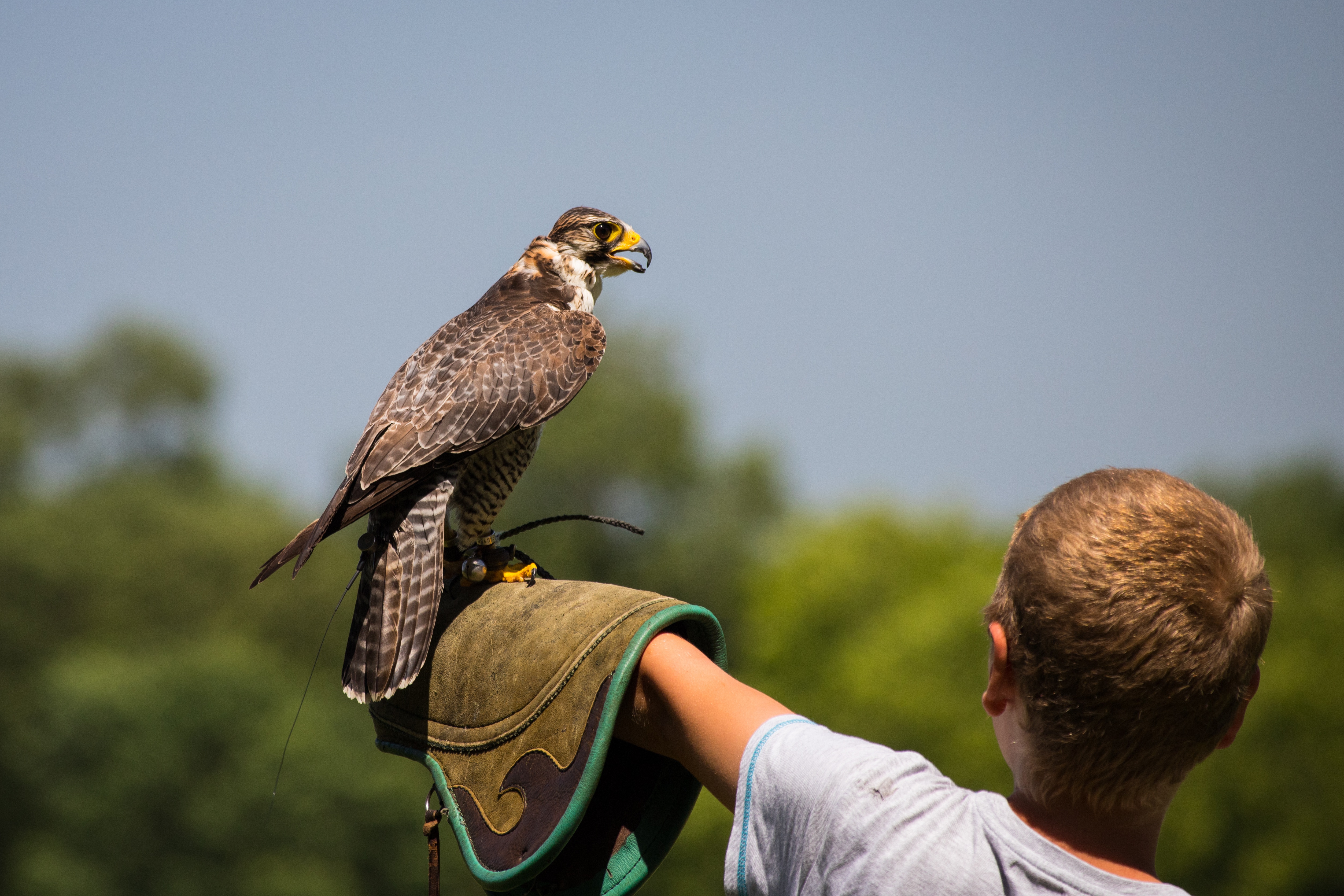
Falcons are long-winged raptors built for speed in open country. The American Kestrel is the smallest falcon commonly flown and is available to apprentice falconers. Peregrines, Prairie Falcons, and Gyrfalcons are flown at the General and Master levels.
| Species | Sex | Avg. Weight (g) | Typical Flying Weight (g) | Fat Weight (g) |
|---|---|---|---|---|
| American Kestrel | Male | 110 | 95–107 | 115–130 |
| American Kestrel | Female | 125 | 110–122 | 130–150 |
| Merlin | Male | 165 | 145–160 | 175–195 |
| Merlin | Female | 210 | 185–205 | 220–250 |
| Peregrine Falcon | Male (tiercel) | 610 | 540–590 | 640–720 |
| Peregrine Falcon | Female | 950 | 850–930 | 1,000–1,100 |
| Prairie Falcon | Male | 530 | 470–520 | 560–630 |
| Prairie Falcon | Female | 750 | 670–735 | 790–880 |
| Gyrfalcon | Male | 1,070 | 960–1,050 | 1,130–1,250 |
| Gyrfalcon | Female | 1,590 | 1,420–1,560 | 1,680–1,850 |
Daily Weight Management Tips
- Weigh at the same time every day. Most falconers weigh first thing in the morning before feeding. Consistency eliminates variables like crop contents and hydration level.
- Account for weather. Birds burn more calories in cold weather. You may need to feed slightly more on cold days to maintain flying weight without dropping too low. Conversely, hot days may require less food.
- Track casting. A bird that has not cast (regurgitated its pellet) will weigh heavier than expected. Wait for casting before drawing conclusions about weight trends.
- Use quality food. Quail, mice, and day-old chicks are common staples. Whole prey items provide necessary roughage for casting. Avoid feeding lean meat alone - raptors need bone, fur, and feather for complete nutrition.
- Never fly a bird below its safe minimum. If a bird appears lethargic, fluffed up, or reluctant to fly, it may be too low. Feed it immediately and do not hunt that day. Consult your sponsor or an avian veterinarian if the bird does not recover quickly.
- Understand seasonal variation. Raptors naturally gain weight in late autumn and lose weight in early spring. Your bird’s flying weight may shift 20–40 grams over the course of a hunting season.
- Use gram-accurate scales. Kitchen scales that read only in 5-gram increments are not precise enough. Invest in a scale with 1-gram resolution and a capacity of at least 2,000 grams for buteos.
Find Scales & Health Tools
Browse digital scales, weight tracking tools, and raptor health supplies in our directory.
Browse ProductsSell Falconry Equipment?
List your products and reach falconers searching for scales and health supplies.
Add Your Business